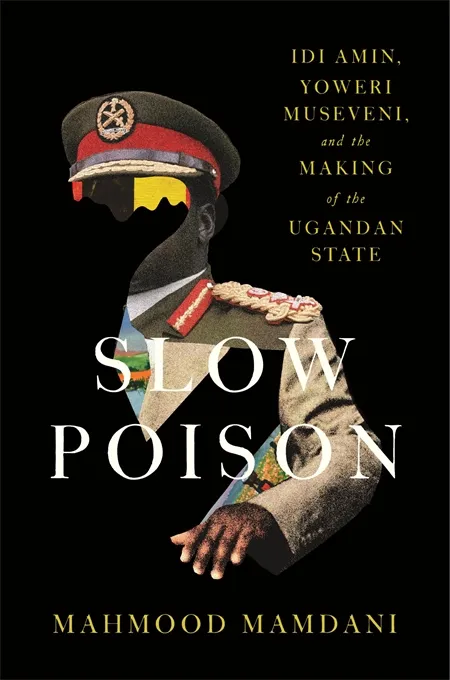
Slow Poison: Idi Amin, Yoweri Museveni, and the Making of the Ugandan State
by Mahmood Mamdani
In 1972, when Mahmood Mamdani came home to Uganda, he found a country transformed by “an orgy of violence.” Two years earlier, with support from the colonial powers of Great Britain and Israel, Idi Amin had forcefully cemented his rule. He soon expelled Uganda’s Indian minority in hopes of fostering a nation for Black Ugandans. The plan backfired. Amin was followed by Yoweri Museveni, who has now ruled for nearly four decades. Whereas Amin tried to create a Black nation out of the majority, Museveni sought to fragment this majority into multiple ethnic minorities, re-creating a version of colonial indirect rule.
Slow Poison is Mamdani’s firsthand report on the tragic unraveling of his country’s struggle for decolonialization. A witness to East Africa’s endlessly intricate power plays, and one of the most insightful political philosophers of his generation, Mamdani casts a learned and wary eye on Amin, internationally depicted as a buffoon; the radical scholar Museveni; and the global heavyweights that exploited and manipulated Uganda before and after its independence.
Each leader made violence central to his project, but Mamdani sees a signal difference between Amin, who retained popular support to the end, and Museveni, who has not. The Asian expulsion made Amin a monster in the eyes of the West. In contrast, Museveni was hailed as standard bearer of the “war on terror” in Africa and was protected from accountability for far greater crimes. In exchange for adopting the package of neoliberal reforms known as the Washington Consensus, he became Africa’s poster child. Amin, who aimed to create a nation of Black millionaires, never became one himself. Meanwhile, Uganda’s surrender to privatization has brought Museveni’s family immense wealth, even as the country remains one of the world’s poorest.
About the Author
Mahmood Mamdani is the Herbert Lehman Professor of Government. He was also professor and executive director of Makerere Institute of Social Research (2010-2022) in Kampala, where he established an inter-disciplinary doctoral program in Social Studies. He received his PhD from Harvard University in 1974 and specializes in the study of colonialism, anti-colonialism and decolonisation. His works explore the intersection between politics and culture, a comparative study of colonialism since 1452, the history of civil war and genocide in Africa, the Cold War and the War on Terror, the history and theory of human rights, and the politics of knowledge production. Prior to joining the Columbia faculty, Mamdani was a professor at the University of Dar-es-Salaam in Tanzania (1973–1979), Makerere University in Uganda (1980–1993), and the University of Cape Town (1996–1999). He has received numerous awards and recognitions, including being listed as one of the "Top 20 Public Intellectuals" by Foreign Policy (US) and Prospect (UK) magazine in 2008. In 2021, he was nominated Among ‘The World’s Top 50 Thinkers’ by Prospect Magazine, UK.
About the Speakers
Manan Ahmed is a historian of South Asia and the littoral western Indian Ocean world from 1000-1800 CE. His areas of specialization include intellectual history in South and Southeast Asia; critical philosophy of history, colonial and anti-colonial thought. He is interested in how modern and pre-modern historical narratives create understandings of places, communities, and intellectual genealogies for their readers.
Rosalind C. Morris is a Professor in the Department of Anthropology at Columbia University. Her work is addressed to the histories and social lives—including the deaths and afterlives—produced in the interstices of industrial and resource-based capitalism in the Global South. Those interests extend to the technological and media forms that attend or undergird these economies, and the forms of subjectivity produced in their midst. They also encompass the racialized and sexualized political logics and structures of desire accompanying these phenomena. Morris’ recent writings on these subjects are grounded in deep ethnographic research in Southern Africa, an engagement that now stretches over more than two and a half decades; her early work was centered on mainland Southeast Asia, especially Thailand. Morris is the author, most recently, of Unstable Ground: The Lives, Deaths, and Afterlives of Gold in South Africa, which won the 2025 Columbia University Press Distinguished Book Award.
Howard W. French is a Professor of Journalism at the Columbia Journalism School. He is also a career foreign correspondent and global affairs writer and the author of six books, including three works of non-fiction, a work of documentary photography and a book from Norton Liveright about Africa and the birth of modernity. His book Born in Blackness: Africa, Africans and the Making of the Modern World, 1471 to the Second World War, was published by Norton/Liveright in October 2021. His immediate previous book, Everything Under the Heavens: How the Past Helps Shape China’s Push for Global Power, was published by Knopf in March 2017, was widely reviewed and featured by The Guardian and other publications as one of its notable books of the season. French is the author, most recently, of The Second Emancipation: Nkrumah, Pan-Africanism, and Global Blackness at High Tide, which was one of Publisher Weekly’s Best Books of 2025.
Please email [email protected] to request disability accommodations. Advance notice is necessary to arrange for some accessibility needs. This event will be recorded. By being present, you consent to the SOF/Heyman using such video for promotional purposes.