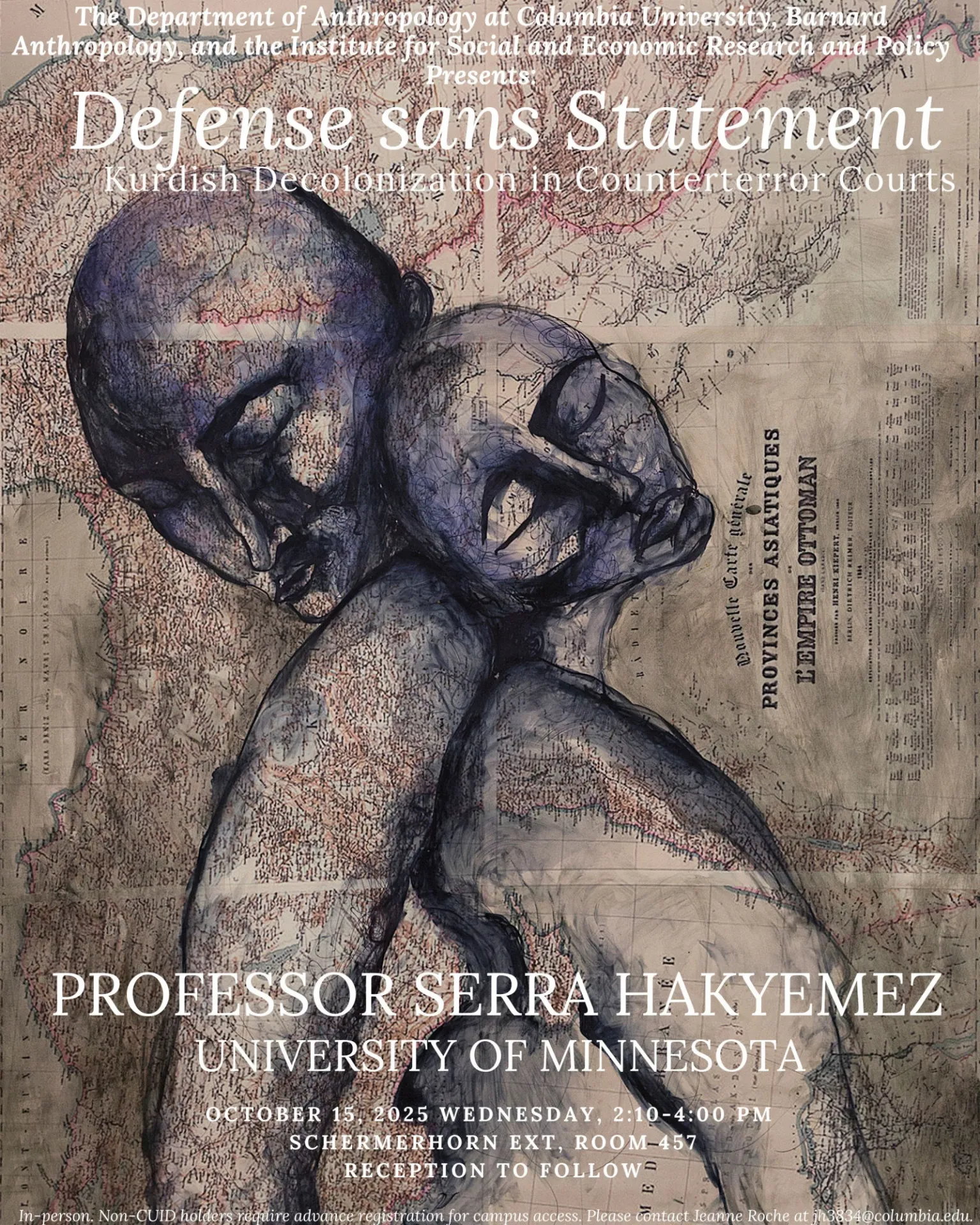
Defense sans Statement: Kurdish Decolonization in Counterterror Courts
What is the possibility of defense for Kurds charged with the terrorist crimes that their "data doubles" are accused of committing? Is it ever possible for detainees facing long prison sentences to overcome the law’s suspicion of deception by making statements, the falsity of which is assumed a priori by the judges? This talk concentrates on the mother tongue protests launched by Kurdish detainees in Turkish counterterror courts between 2011 and 2013 to address these questions. If defense statements that demand the recognition of one’s identity fall into the cracks for not implicating the defendants’ desire, this talk argues that it is through “defense sans statement” that the detainees might defend themselves. Defense sans statement is a type of defense that is not susceptible to the test of truth and falsity. In a defense sans statement, language is used not to refer to the evidence presented by the prosecution or to present counterevidence to the judge. Instead, detainees interrupt the communicative duel in courts by using language to index that which cannot be linguistically represented. This ethnography on the Kurds' refusal to speak will also be used to invite the audience to discuss the accusations of supporting "terrorism" leveled against Palestinian students, scholars, and their allies on university campuses and beyond.
Dr. Serra Hakyemez is McKnight land-grant professor (2024-2026) and assistant professor in the Department of Anthropology and the Institute for Global Studies at the University of Minnesota, Twin Cities. Her research examines the forms that colonial state projects assume in the contemporary Middle East and East Africa. Through studying institutions ranging from counterterror courts and maximum-security prisons in Northern Kurdistan to humanitarian relief and development agencies in Somalia, she explores the relationship between subjection and subjectification, law and justice, and politics and ethics. Her first book Deadly Refusals: Kurdish Decolonization in Times of Counterterrorism (University of Minnesota Press, 2026), offers an intimate portrait of the Kurdish liberation movement within the carceral and legal apparatuses of the Turkish state. Based on ethnographic research conducted over a period of seventeen years—including interviews with former prisoners, lawyers, judges, and prosecutors; observations of more than one hundred court hearings; and analysis of prison memoirs, poetry, and legal archives—Deadly Refusals examines how prosecuted and imprisoned Kurds organize in refusal of the criminalization of their political demands and colonization of their political desires. This research was supported by multiple grants from the American Council of Learned Societies, National Science Foundation, and the Wenner-Gren Foundation.
Please email [email protected] to request disability accommodations. Advance notice is necessary to arrange for some accessibility needs.