Stained Bodies: Rethinking Latin American Racial Difference through a Disappearing Birthmark
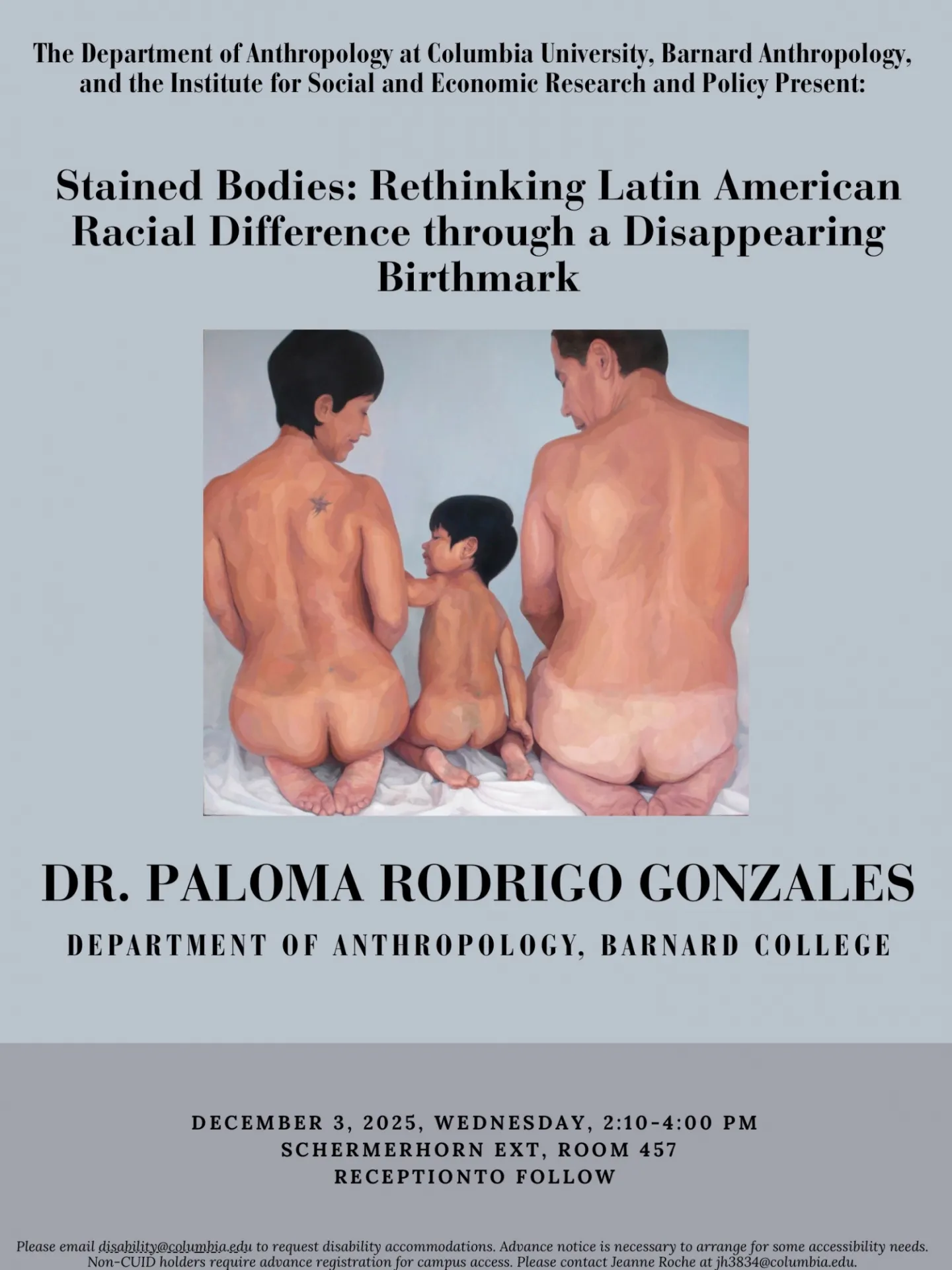
The mancha mongólica—a bluish or greenish birthmark that appears on the sacral area of newborns and disappears gradually after birth—is a corporeal sign through which race has been imagined, interpreted, and contested in Latin America. Commonly read as evidence of Indigenous or Black ancestry, the mancha offers a unique entry point into the intertwined histories of race, science, and everyday life in the region. Drawing on oral histories, literary representations, and scientific writings, this talk traces how a temporary physical mark acquires enduring symbolic and evidentiary power. The mancha mongólica illuminates the paradox of racial discourse in Latin America, where structural racism pervades alongside its persistent denial. Ultimately, the presentation examines the epistemic logic linking visible bodies to invisible traits, while questioning inherited racial categories and their colonial-scientific origins.
Paloma Rodrigo Gonzales is a cultural anthropologist whose work focuses on race and racism in Peru and Latin America. Currently, she is an Early Career Faculty Fellow at Barnard College. She holds a PhD in Anthropology from the Graduate Center of the City University of New York and an MA in Latin American Studies from the University of California, San Diego.
Please email [email protected] to request disability accommodations. Advance notice is necessary to arrange for some accessibility needs.