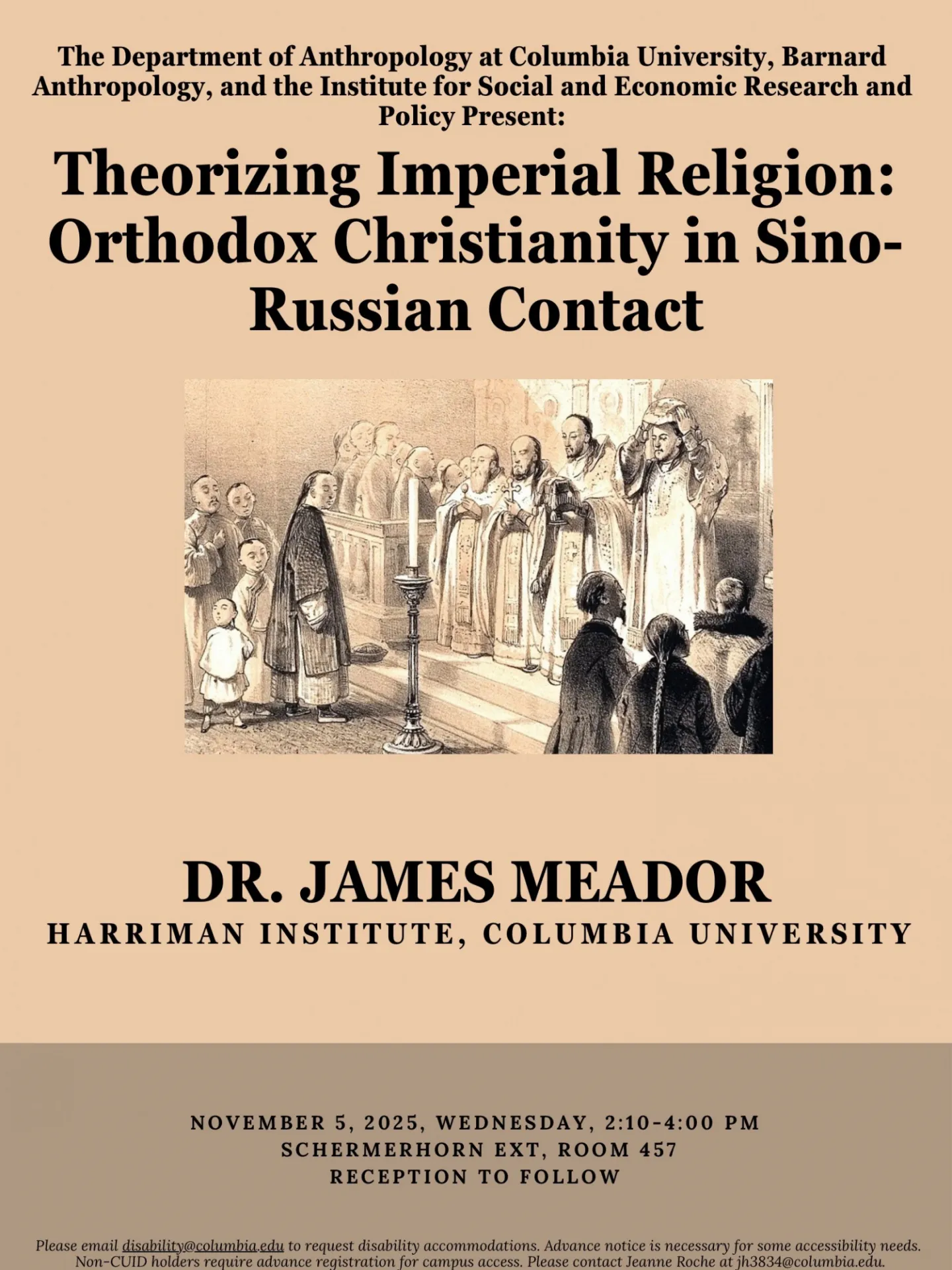
Theorizing Imperial Religion: Orthodox Christianity in Sino-Russian Contact.
How can one see imperial states as something other than the shadow cast by nation-states? This talk sketches the outline of one such account of empire through a focus on religion. Specifically, it approaches religion as a vector for state effects that cross territorial borders. The bulk of this talk traces a tiny group of Chinese Orthodox Christians across four centuries of contact between imperial, socialist, and post-socialist Russia and China. These Chinese Orthodox maintained a loose hereditary adherence to the state religion of the Russian Empire, a faith passed down from their distant Russian ancestors. This legacy of extraterritorial state religion has been repeatedly rediscovered and re-appropriated in collaboration with agents of the Russian Empire and its territorial successors. The renegotiation of mutual relationships between Russian and Chinese subjects through the idiom of religion paints Orthodox Christianity as a catalyst of formal and informal connection, one that has proved in some respects more durable than the states whose subjects it has connected. By reconstructing transformations in Orthodox intermediaryship across a series of political ruptures, imperial religion comes into focus as a dialectical relation between ambiguous connection and retrospective recuperability, a dialectic whose threats and promises have haunted a tiny group of Russophone elites and Chinese Orthodox for centuries.
James Meador is a linguistic anthropologist and anthropological historian of Sino-Russian borderlands. They hold a Ph.D. in anthropology from the University of Michigan and are currently a postdoctoral fellow at the Harriman Institute, Columbia University.