ABSTRACT
How much does understanding matter when communicating across diverse languages and contexts? In International Sign (IS)—a translingual form of communication used by deaf people across national sign language borders—understanding is a constant negotiation. My ethnographic films bring to life the moments where deaf people grapple with IS at international events, highlighting the real dilemmas that arise when participants have different fluency levels and varying expectations of what it means to understand something.
In these settings, presenters, performers, and audiences are often forced to compromise. They face difficult choices about what to prioritize—speed, inclusion, or clarity—knowing that full understanding is not always achievable. Yet this doesn’t necessarily mean that communication fails. Even when understanding is compromised, IS interactions can still create opportunities for meaningful interaction, though some people may remain at the fringes. This raises a critical question: what happens when the aspiration for mutual understanding collides with the reality of these compromises? Can value be found in these gaps, or do they establish hierarchies that leave certain participants persistently excluded?
Rather than viewing understanding as the ultimate goal, I suggest that the compromises people make in communication—whether by sacrificing precision, allowing space for uncertainty, or focusing on shared experiences—might be just as important. IS users adapt and modify their communication, making choices that go beyond simply aiming to be understood. These decisions show that connection can sometimes be about making space for what remains unsaid, unfinished, or unresolved.
BIO
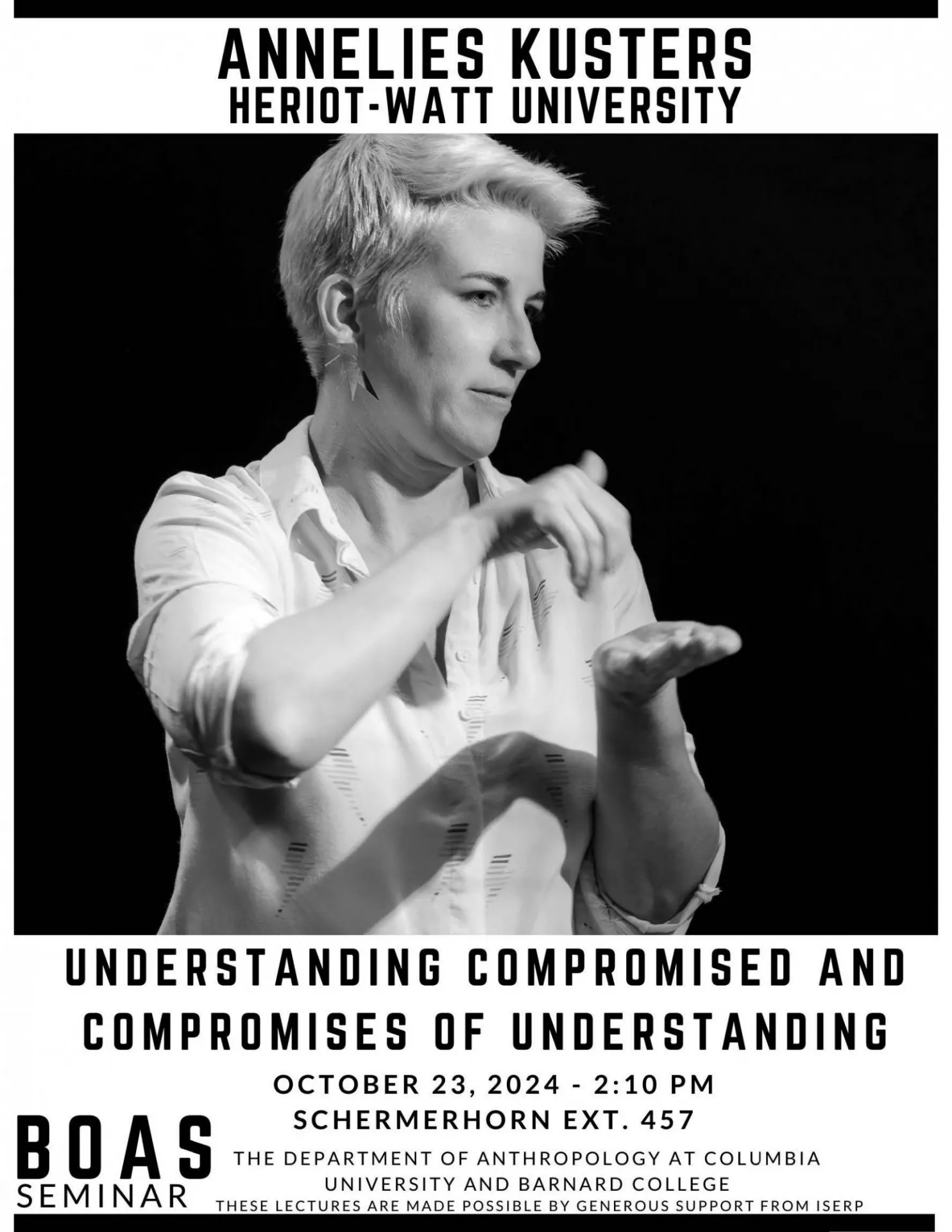
Annelies Kusters (she/her) is Professor of Sociolinguistics at Heriot-Watt University, with a strong interdisciplinary background. She is a deaf Belgian woman who holds a bachelor’s degree in Philosophy, master’s degrees in Anthropology and Deaf Studies, and a PhD in Deaf Studies. With a passion for ethnographic research, she has conducted extensive fieldwork across diverse locations including Ghana, India, and the United Kingdom. Her research spans transnationalism, mobilities, and language ideologies. She has produced seven full-length ethnographic films, reflecting her commitment to using linguistic ethnography to study communicative dynamics and experiences of deaf people globally.
NOTE: Please note that, at present, non-Columbia affiliates must request and receive approval to attend events on campus. To obtain a QR code that will permit campus access, please contact professor Rosalind Morris at [email protected] at least 36 hours before the event, to permit processing of the request.