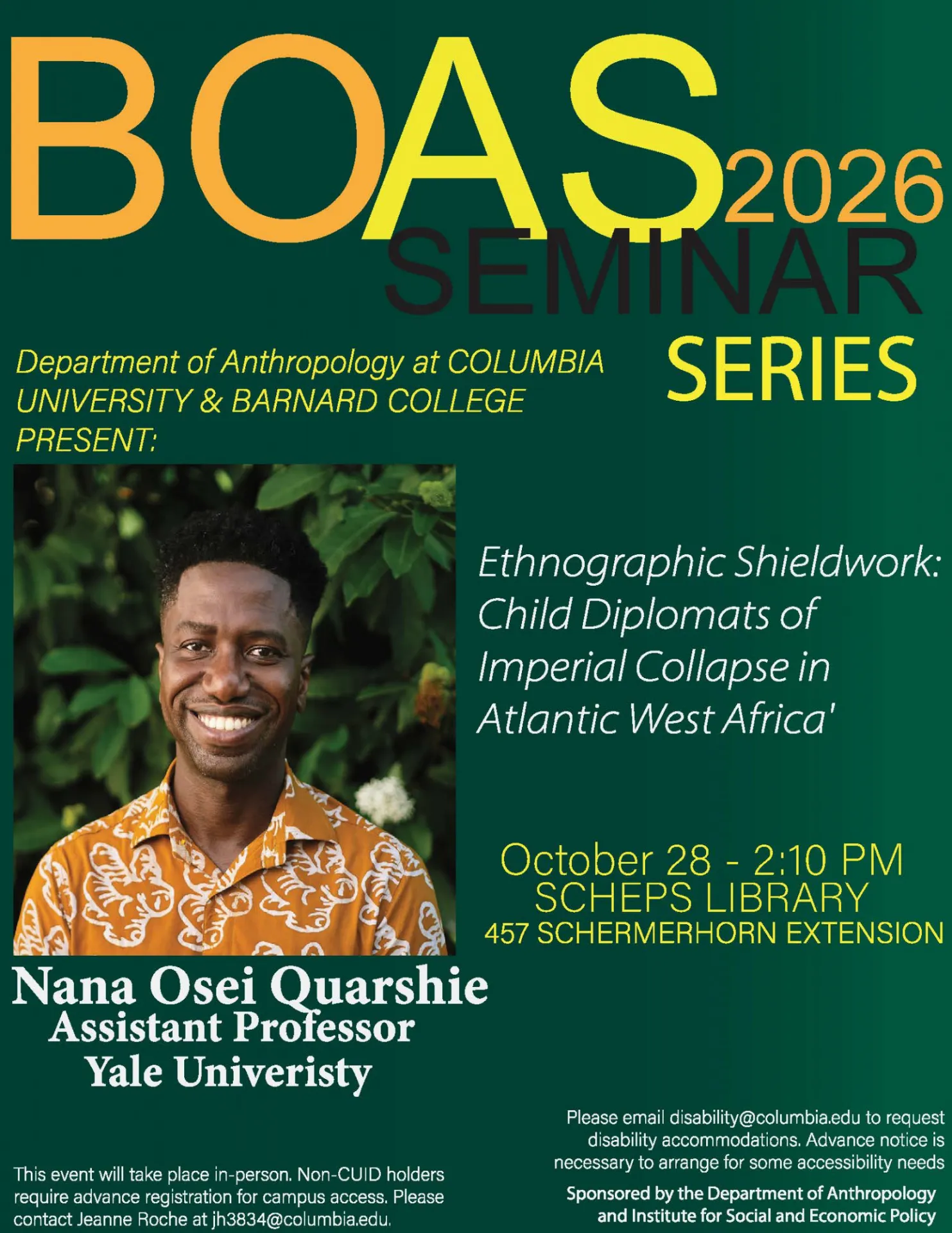
Contrary to a longstanding assumption in the history of social sciences, European anthropologists, travel writers, and missionaries did not introduce ethnological thought to West Africa. Since at least the early seventeenth century, West African political leaders sent their sons and nephews to live as shield-bearers in the courts of African trading partners to study the languages, cultural dispositions, and governance strategies of their hosts through intimate proximity. Shield-bearing, which is still practiced in several royal courts in West Africa, was polyvalent. It was a cultural tradition of martial arts, dance and heraldry. It was a form of political hostage-taking analogous to the rise of pawnship as a regional credit system. This talk examines shield-bearing as a diplomatic institution built upon a research methodology that I call “ethnographic shieldwork,” in which young nobles imbibed the knowledge economies of hosting governments through a combination of immersive study of court histories, the physical discipline of acrobatic dance and shield manipulation, and intimate service to hosting royals. A diplomatic institution that operated as a training method for a future in political power, shield-bearing was an embodied ethnological epistemology grounded in an ethnographic methodology. While recent scholarship shows African royals sending their sons to Europe for education during the Atlantic era, it overlooks the antecedents for these Afro-European exchanges in intra-African diplomatic practices and embodied epistemologies. Given that Atlantic-era diplomacy depended on literacy in European languages, sources on the exchanges of children point to a transformation of shieldwork from an acrobatic mode of ethnographic exegesis to an increasingly textual method of explication far more akin to the written “fieldwork” of later generations of European travelers and ethnographers.
Nana Osei Quarshie is Assistant Professor in the Program in the History of Science and Medicine at Yale University, where he is also affiliated with the Department of Anthropology and the Yale School of Medicine. An anthropologist and historian by training, Quarshie examines the relationship among mental healing, political expulsions, immigration, and urban belonging in West Africa since the seventeenth century. He is the author of the award-winning monograph, African Pharmakon: The Asylum as Shrine from Slavery to the Return (University of Chicago Press, 2025).
This event will take place in-person. Non-CUID holders require advance registration for campus access. Please contact Jeanne Roche at [email protected].
Please email [email protected] to request disability accommodations. Advance notice is necessary for some accessibility needs.