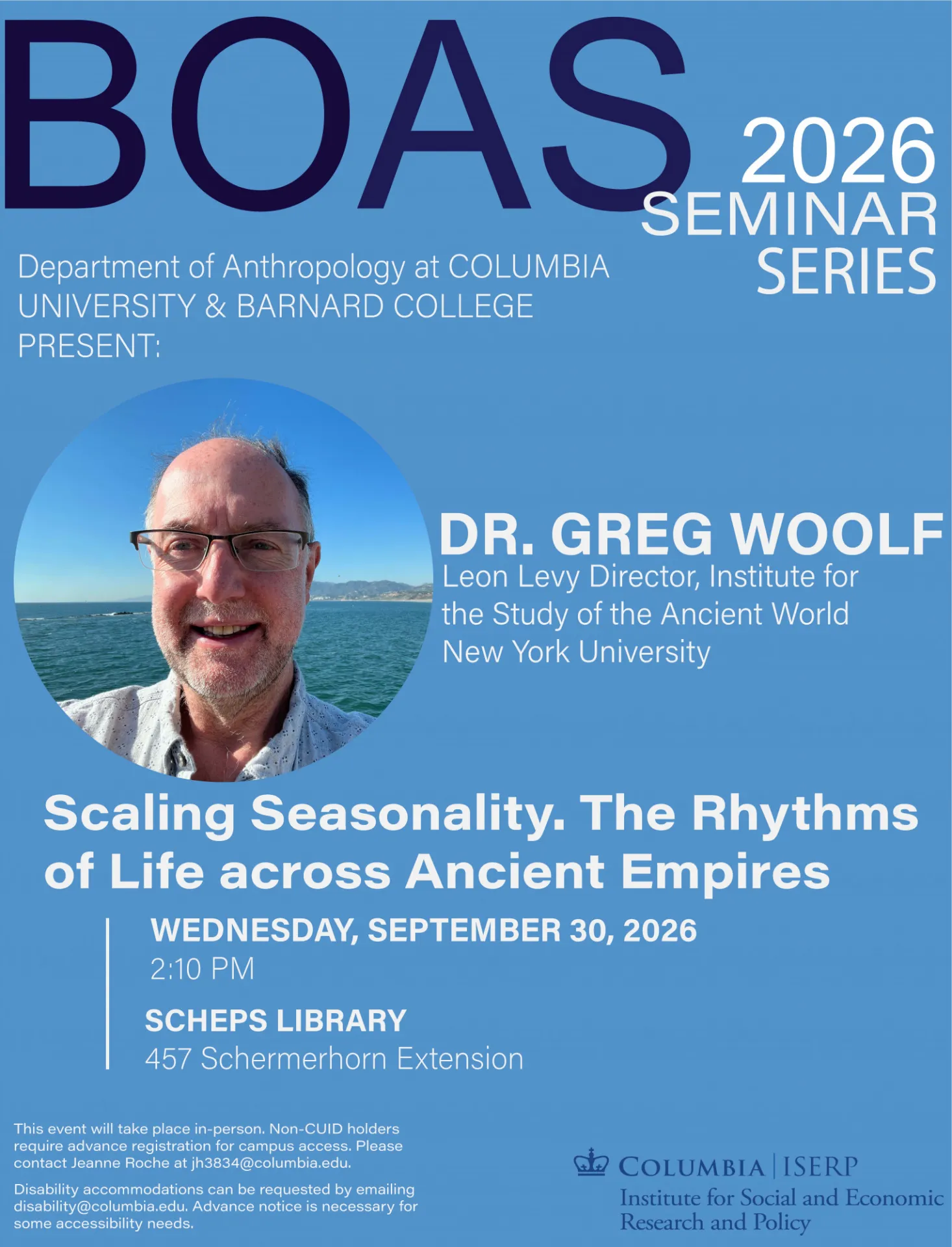
Seasonality has been a recurrent interest of ethnographies from Mauss and Boas to the more recent work of Ingold and Mark Harris. Mostly these studies have explored limiting cases, so-called "small-scale societies' inhabiting landscapes like the Canadian Arctic or the Amazon floodplain characterised by extreme seasonal variations for example of photoperiod and temperature, flooding and tropic weather systems. Yet as Mediterraneanist from Braudel to Boissevain have noted, it is not necessary to travel to landscapes like those to observe seasonal rhythms of life. What complicates the question in early empires is that almost all straddled a range of biomes each with their own seasonal patterning. My aim in this talk is to ask how empires sought to co-ordinate or at least mitigate discordant seasonalities, and also to ask how the seasons of subject communities rubbed up against those of empire. Most of my discussion will concern the ancient Mediterranean world, but I will glance sideways from time to time, and hope that participants in the seminar will help me broaden my perspective.
Greg Woolf has been Leon Levy Director of the NYU Institute for the Study of the Ancient World since January 2025, and before that held chairs at UCLA, University of London and the University of St Andrew. Most of his work has been on the history and archaeology of the Roman world but he has also worked on late prehistoric Europe and his last book was a natural history of ancient urbanism. He has published on economic life, on literary, on ancient knowledge cultures, on religion and especially on the intersections of identity and imperialism. A short book on mobility and migration in the ancient Mediterranean world is in press.
This event will take place in-person. Non-CUID holders require advance registration for campus access. Please contact Jeanne Roche at [email protected].
Disability accommodations can be requested by emailing [email protected]. Advance notice is necessary for some accessibility needs.